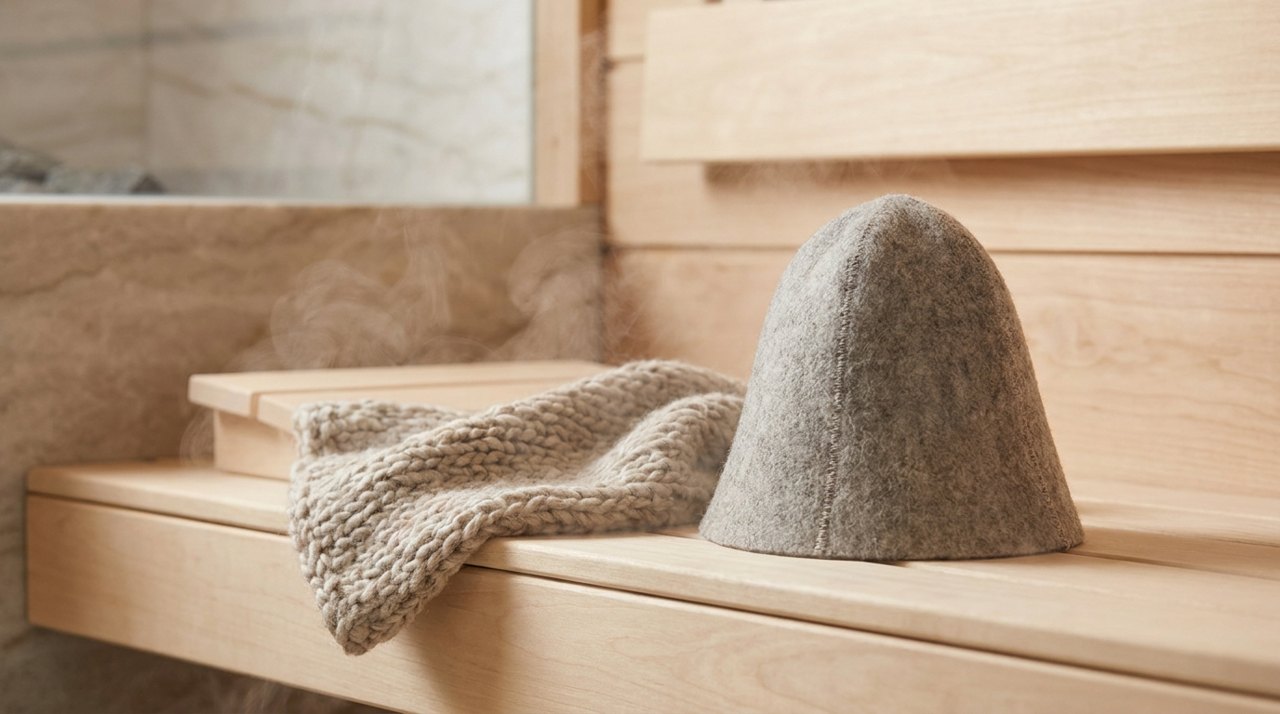
Pick up a traditional banya hat and the first thing you notice is that it isn't knitted at all. There's no visible stitch, no stretch, no yarn structure — just a dense, seamless dome of matted wool that holds its shape like a helmet. That's felt, and it's not an aesthetic choice. Every physical property that makes a sauna hat work — insulation, shape retention at 90°C, moisture handling — comes from the felting process itself. A knitted wool hat, made from the exact same fiber, fails at all three. Here's why.
Both felted and knitted hats can start as 100% sheep's wool, so the difference isn't the material — it's the architecture. Knitting takes spun yarn and loops it into an interconnected lattice. The result is stretchy, breathable, and full of open channels between the loops. That openness is exactly what you want in a winter beanie, where trapped body heat keeps you warm and the fabric flexes with movement.
Felting does something more drastic. Wool fibers are covered in microscopic overlapping scales, like shingles on a roof. When you combine moisture, heat, agitation, and a mild alkaline environment (traditionally soap), those scales open up and lock against each other. The fibers migrate, tangle, and ratchet together permanently — there's no "un-felting" wool, as anyone who has accidentally shrunk a sweater knows. The finished material is a nonwoven mat: no yarn, no loops, no directional grain, just millions of fibers interlocked in every direction.
For sauna purposes, that structural difference changes everything.
A sauna hat's job is counterintuitive — it keeps heat out, not in. At 80–100°C, your head is the most heat-exposed part of your body, and the hat works as a thermal barrier so you can stay in the steam room longer without your scalp and ears overheating.
Insulation, in any material, comes down to trapped, motionless air. Felt excels here because its randomly tangled fiber mat creates millions of tiny, sealed air pockets that hot air can't circulate through. A knit, by contrast, has continuous open channels between its loops. Hot sauna air flows straight through those channels and reaches your scalp. The knit hasn't failed as a fabric — it's simply doing what knits do, which is breathe. In a sauna, breathing is the opposite of what you want from your headwear.
Thickness matters too. Quality felt hats run 3–5 mm thick, a wall of dead air a knit of comparable weight can't match without becoming absurdly bulky.
The classic banya hat shape — a tall cone or bell that stands away from the head — isn't decorative. The air gap between the felt and your scalp is a second layer of insulation, and it only exists if the hat holds its structure.
Felt is self-supporting. Because the fibers are locked mechanically in three dimensions, a felted dome behaves almost like a rigid shell: it stands up on its own, keeps the air gap intact, and doesn't sag when it gets warm and humid. A knitted hat has no such skeleton. Heat and moisture relax the yarn, the loops stretch under their own weight, and within minutes the hat is drooping against your skin — collapsing the air gap and turning itself into a warm, wet compress. Worse, a knit hat in repeated sauna use is slowly felting itself anyway, shrinking and distorting unpredictably with every session. Felt has already been through that transformation under controlled conditions; it has nowhere left to shrink to.
Wool can hold up to roughly 30% of its weight in water vapor before it even feels damp, and it releases a small amount of heat as it absorbs moisture. Both felt and knit share this fiber-level chemistry. The difference is what happens at the fabric level.
Felt absorbs sweat and steam into the mat and spreads it laterally through the tangled structure, while the density slows liquid water from wicking straight through to your head. Condensation from the steam room stays largely on the outer surface. A knit, with its open structure, saturates quickly and channels moisture directly inward — a soaked knit hat against your scalp conducts heat far better than dry air does, which actively undermines the insulation you wore the hat for. We cover the material side of this in more depth in Wool vs Synthetic Sauna Hats: The Material Truth, but the short version is: wool's moisture behavior is a gift, and felt is the structure that lets you keep it.
A sauna is about the harshest environment you can subject headwear to: repeated cycles of extreme heat, near-total humidity, sweat salts, and sometimes a plunge-pool dunk. Felt tolerates this remarkably well precisely because it has no structure to unravel. There are no stitches to snag, no seams under tension (many felt hats are molded seamlessly), no yarn to pill or run. A well-made felt hat that's dried properly between sessions lasts for years of weekly use — the care routine is genuinely simple, and we've written it up in our full care guide.
| Property | Felted wool | Knitted wool |
|---|---|---|
| Structure | Dense nonwoven mat, fibers locked in all directions | Looped yarn lattice with open channels |
| Insulation in sauna heat | Excellent — trapped still air blocks heat | Poor — hot air flows through the loops |
| Shape at 90°C + humidity | Self-supporting, keeps its air gap | Sags and collapses against the scalp |
| Moisture behavior | Absorbs and spreads; resists soak-through | Saturates fast, wicks inward |
| Long-term stability | Pre-shrunk by design; nothing to unravel | Shrinks and distorts with repeated use |
None of this is a modern discovery. Russian banya culture arrived at felt hats through generations of trial and error, long before anyone could explain thermal conductivity. Felt-making itself predates knitting by millennia — nomadic peoples of the Eurasian steppe were felting wool for yurts, boots, and hats thousands of years ago, precisely because felt was windproof, water-resistant, and structurally rigid. When bathhouse culture needed head protection from steam, felt was the obvious and, really, the only candidate. The pointed and bell-shaped silhouettes you still see today are functional designs refined over centuries: maximum air gap, full ear coverage, a brim that keeps drips off the face.
Modern makers haven't changed the formula because there's nothing to change. A hat like the DIVELUX wool sauna hat is doing exactly what a Novgorod bathhouse hat did five hundred years ago — thick pressed wool, seamless dome, generous coverage — just with more consistent felting and cleaner finishing. If you prefer a different shape or color, the broader DIVELUX sauna hats collection works from the same felted-wool foundation, and the classic grey is also available on Amazon if that's your usual route.
If a hat is marketed for sauna use, it should be felt — full stop. Knitted wool is wonderful fabric in the wrong job: too open to insulate against 90°C air, too floppy to hold an air gap, too eager to soak through. Felting takes the same fiber and rebuilds it into a dense, rigid, moisture-buffering shell that happens to be the ideal head insulator ever devised for a steam room. When you're comparing hats, check the label for genuine felted wool — and if you're unsure what those labels actually mean, our breakdown of what "100% natural wool" really means will help you read past the marketing.
Handmade from 100% natural wool felt. 7 colors, classic and bucket styles, one size fits most. $19.99 with free US shipping and 30-day returns.
Shop DIVELUX sauna hats →